In Memoriam

In Memoriam: Neil Armstrong

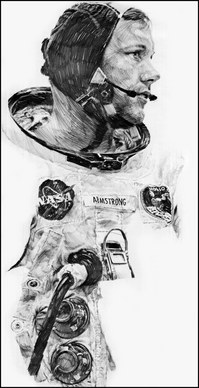
neil-armstrong_by-paul-calle

The word “hero” gets tossed around a lot these days, but it’s oftentimes not really deserved, in my opinion. That’s not to disparage anyone, or diminish whatever it is that they do. Rather, it’s the word that has been diminished in recent years, through overuse and misuse. One can do admirable things without being a hero. And there’s a lot more to being a hero than simply taking a particular job or wearing a particular uniform. In my mind, “hero” is a description that ought to be reserved for the truly exceptional, people who not only do great things but have a certain quality of character as well.

Just about every article and note of remembrance I’ve read about Neil Armstrong, who died Saturday at the age of 82, has described him as a hero. In his case, I’d say the word is entirely appropriate. Not just because he was arguably the most famous astronaut in the history of manned spaceflight… although I believe he most likely is. And also not just because he was an incredible pilot who saved two spacecraft during his astronaut career: first, the Gemini VIII capsule which tumbled out of control after a thruster malfunctioned, and then the lunar module that carried him and Buzz Aldrin to the Sea of Tranquility. (I don’t know if this is well known outside the space-nerd community, but the LM’s computer was overwhelmed with incoming data and kept shutting down, and was also trying to steer the craft toward a boulder field, so Armstrong took manual control and flew around until he spotted a safe landing site, finally bringing the LM down with only 30 seconds of fuel remaining.) His crewmates on those occasions both described him performing with an almost preternatural calm and grace under pressure. But those characteristics don’t make him a hero either; they just indicate he was very good at his job.

I don’t even think he was heroic for being the first human being in the history of our species to set foot on a planetary body other than the earth. Although that’s certainly a great deed, there wasn’t anything about Armstrong himself that led to him being that man. It could just as easily have been Aldrin who was selected to exit the LM first… or it could have been any of the other Apollo astronauts if the crew rotations and mission plans had gone differently. It very likely would have been Gus Grissom if the Apollo 1 fire hadn’t occurred.

What made Armstrong a true hero, in my book, was the way he responded to becoming that historic figure. His famous words about small steps and giants leaps — reportedly composed by Armstrong himself on the way to the moon, and not ahead of time by a professional speech writer or NASA PR flack — were not political or nationalistic or self-aggrandizing, as they easily could have been. Rather, he spoke on behalf of the entire human race, and beautifully so. And when he returned home, he displayed great humility and self-deprecation in his decision to stay out of the spotlight as much as possible. He could have used his position in the history books for personal advantage, parlaying his fame into political appointments or movie roles or high-paying endorsement deals. Or he could’ve simply become an insufferable braggart. To my knowledge, though, he never even tried to get so much as a free beer in a small-town tavern. Many people were puzzled and frustrated by his efforts to live under the radar, as he routinely turned down requests for interviews and personal appearances, and eventually even autographs. Personally, I admire him for it. I don’t read his reticence as reluctance to own the “first man on the moon” title, or as an urge to hide from the public. Rather, I think he was wise enough to understand that he was merely a human being, and that the historical Neil Armstrong, the one who will live on in legends and fuzzy black-and-white video recordings centuries after the actual man is forgotten, would be impossible to actually live up to. He receded from the public eye both for his own good and for ours, to save us from the disappointment of learning he wasn’t a superman or a demigod, but merely a guy from Ohio. A guy who couldn’t have become that legendary moonwalker without the assistance of thousands of others. I see his years of obscurity as another kind of selfless act, akin to the same selflessness he displayed at the moment he dropped off the LM’s ladder into the unknown powdery soil of our nearest cosmic neighbor. He was a hero precisely because he never tried to be a hero.

He was certainly a hero to me. I wish I’d had an opportunity to meet him. To shake his hand and maybe ask him how his crops were faring. (He spent his later years raising cattle and corn on a 300-acre ranch outside Cincinnati. Talk about coming back down to Earth.) And even though he wouldn’t have asked me to buy him a beer, I most certainly would have. The man did walk on the frackin’ moon, after all…

***
Image: a 1969 sketch by Paul Calle, courtesy of The Pictorial Arts.

spacer

35 Years Tonight

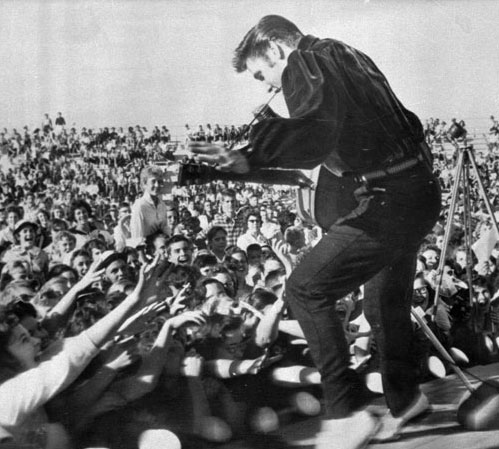
A lifetime ago. I was seven then. He was the age I am now, 42. And my mother was younger than I am now, as hard as that is to wrap my head around. The untimely, undignified, sadly unnecessary death of Elvis Presley, and Mom’s heartfelt, deeply wounded reaction to the news, remains one of the landmark moments in my developing awareness of the world around me, even after all this time.

And yet I’m not sure this anniversary has much relevance any more. Not the way it used to, even as recently as just a decade ago. Elvis still has legions of fans, and they still gather every year at his home in Memphis to hold vigil and pay tribute… but unlike, say, Marilyn Monroe, whose image remains as omnipresent as it ever was, if not moreso, it doesn’t seem to me like we see or hear much about the King of Rock and Roll anymore. I accepted some time ago that pop-cultural icons don’t endure the way we fans expect or desire them to — talking about the once universally beloved Star Wars these days seems to inevitably lead to an argument, and even the mighty Star Trek franchise has receded from the public consciousness, something I wouldn’t have thought possible during its heyday in the ’90s — but I am truly surprised that Elvis has lost his pre-eminence in the zeitgeist. It could be a failure of marketing — maybe the owners of Marilyn’s likeness push a lot harder? — but I suspect it’s something more organic. Possibly all those years of bad-taste fat-Elvis jokes and ridiculous impersonators have blotted out the cultural memories of who he really was, and why he once excited us. Maybe it’s something more ineffable. Whatever the reason, though, Marilyn’s image (if not her actual work or personality) resonates with younger folks whereas Elvis’ does not.

Or at least that’s how it seems to me. I could be completely wrong on this. I admit I’m not nearly as plugged into this stuff as I used to be, and the mass culture we all used to share has atomized to the point where it’s easy to miss out on things if you’re not following the right newsfeeds. Nevertheless, I have this nagging sense that Graceland may ultimately meet the same fate as the Roy Rogers Museum, which closed a few years ago because attendance had dwindled as Roy’s core fans aged out and passed on. I don’t entirely understand how something like that can happen, given how popular that man once was. Why does an artist like Frank Sinatra transcend the generations and continue more or less in perpetuity, but not someone else who was (arguably) more popular — or at least as popular — in his day? (Nothing against Sinatra, he’s just a good example of an artist who’s endured long after his contemporaries have been forgotten.)

Am I wrong about this? Either way, I’m thinking more and more that I should make the effort to take my mom on a pilgrimage to Memphis before too many more years pass…

elvis_young_performance

spacer

In Memoriam: Sally Ride

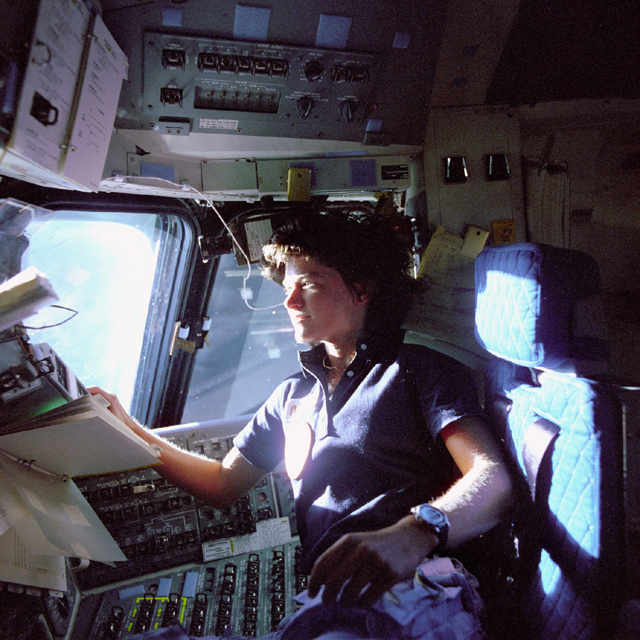
sally_ride_on_flight_deck
Dr. Sally Ride, the first American woman in space, has died of pancreatic cancer at the too-young age of 61. If you can’t quite recall these things, she flew aboard space shuttle Challenger on only its second mission in 1983, and again on Challenger in 1984. She was scheduled for a third flight, but that was scuttled following the Challenger disaster in ’86. She served on the presidential commission that investigated that accident, then retired from NASA in ’87. She was subsequently recalled from academia to serve on the board that investigated the loss of space shuttle Columbia in 2003.

She’s often called a role model for girls (for understandable reasons), but I have to say this boy always considered her a hero as well, right up there with all the male astronauts, as she deserved. It’s a shame kids today are more likely to look up to the Kardashians than a woman — than a person — like this. A brave and determined person who championed education and science and did her best to push back the frontier — all sorts of frontiers — just a little more for the rest of us.

Goddamn cancer. It’s getting personal now.

spacer

In Memoriam: Bob Anderson

I’ve just learned that 2012 began with the passing yesterday of the legendary swordmaster Bob Anderson, who trained and/or doubled for every Hollywood swashbuckler from Errol Flynn to Orlando Bloom during his long life. Mr. Anderson was an Olympic fencer who started working in movies in the 1950s as a stunt double on Errol Flynn’s Master of Ballantrae. (He was notoriously known for a time as “the man who stabbed Errol Flynn” because of a minor on-set accident.) Of somewhat more relevance to we nerdy Gen-Xers, Anderson doubled for Dave Prowse as Darth Vader during the climatic lightsaber duels in The Empire Strikes Back and Return of the Jedi. (He wasn’t credited, but no less a source than Mark Hamill — the guy on the other end of Vader’s saber — has reported it was so.) He also trained actors and choreographed fights for The Princess Bride, the Lord of the Rings trilogy, the 1993 version of The Three Musketeers (that’d be the one with Charlie Sheen and Keifer Sutherland), the two Antonio Banderas Zorro flicks, and, of course, the Pirates of the Caribbean movies. He even trained Lindsay Lohan, of all people, for a scene in the remake of Disney’s The Parent Trap.

Anderson’s work first came to my attention as a result of my mid-1990s obsession with the Highlander franchise — he was Sean Connery’s fight double in the original Highlander film, and he worked with the star of the Highlander TV series, Adrian Paul, during that show’s first season. As I read up on him, I was impressed by how many of my favorite films he’d had a hand in. In a sense, he’s had more influence on my cinematic tastes than any other single individual. What an amazing career this man had.

Anderson was 89 years old.

spacer

In Memoriam: 2010 Super Retrospective Edition

I don’t know why I feel compelled to observe the deaths of celebrities the way I do. I only know that I always have, going all the way back to a couple of brief sentences I scribbled in an old pocket calendar on the day Elvis Presley died in 1977. (I was seven years old at the time.) A former girlfriend once told me she thought I was morbid for having such an interest in the passing of people I didn’t even know. I see it differently, of course. No, I didn’t personally know the people I write tributes for, but that doesn’t mean I feel no attachment to them, no grief at the thought that they’re gone, or that their lives — or at least their work — has had no direct effect on my own. Given my interests and obsessions, movie and television actors, novelists, screenwriters, artists, composers, and rock stars have often had more effect on me than many of my own relatives.
In any event, a lot of things got away from me in 2010, including a great many topics I wanted to blog about, and my patented celebrity obits comprise a pretty large subset of those lost blogging opportunities. That’s a tremendous source of frustration for me; I feel like I’ve failed at some kind of calling, as pretentious and self-important as that probably sounds. But I feel what I feel, right?
To try and make up a little for my “In Memoriam” failings, I will now present a list of all the celebrities who died in 2010 that I felt worthy of mentioning. They all deserve more than a bullet point, but I’m afraid that’s all I have time to give them. A handful of them did get a little more, up toward the first of the year, before the Summer Work Apocalypse got its claws into me. Those people’s names are hyperlinked to the relevant posts.
And to anyone who may agree with that long-gone girl and thinks I’m being morbid, I assure you I really did feel some connection to everyone on this list, even if it was simply a sense of familiarity due to their faces being on TV all the time as I was growing up.

spacer

In Memoriam: John Barry

A number of blogs have already commented on yesteday’s passing of film-music composer John Barry, aged 77, and I have little more to contribute except to note that a number of his scores rank among my all-time favorite music of any genre. (Yes, this formerly mullet-wearing rock-and-roll fan does have other musical interests, believe it or not!) Everyone seems to be focusing on Barry’s work for the James Bond films, but personally I love the moody atmosphere he brought to The Black Hole and the languid romanticism of both Out of Africa and Raise the Titanic (a near-universally panned film, but a lovely soundtrack).

Barry’s music was big and sentimental and it often took its time to develop a theme, making it perfectly suited for epic movies that wear their emotions on their sleeves — sadly, a type of film that nobody seems interested in making anymore. It’s therefore fitting that his last truly great work (in my admittedly biased opinion) was the soundtrack for one of the last great sentimental epics, Dances with Wolves. Oh, stop sneering. I know Dances has never been appreciated by the hipster movie-snob crowd, but for me it has always been and still remains deeply moving. It came along at just the right time in my life, I guess, to fully resonate with me on every imaginable level. And Barry’s music for the film — from the brutal staccato that accompanies the Pawnee attacks to the tender innocence of Two Socks’ theme to the blood-thumping grandeur of the buffalo hunt — is nothing short of sublime.

My favorite music from the movie, though — my favorite Barry piece, period — is listed on the Dances soundtrack album as “Journey to Ft. Sedgewick,” comprising Lt. Dunbar’s travels across the Great Plains with the grubby muleskinner Timmons early in the film. This piece evokes so much for me: an undefined yearning, a restless curiosity, wanderlust, the excitement of someplace new, the nobility of open spaces, the physical sensation of gazing upon beauty and feeling very small but in a satisfying way… I find this piece immensely uplifting, and of course it brings back a lot of memories of a long-past time in my life when Dances with Wolves was the big event and it was always the golden hour. If you want to know what I was like at the age of 21 — what I hope I’m still like in my better moments — it’s all right here:

spacer

Friday Evening Videos: Ronnie James Dio Commemorative Edition

I wouldn’t call myself a fan of the late heavy-metal singer Ronnie James Dio, who died last week at the age of 67. His music was a little too far to the headbanging side of the spectrum for my tastes (well, except for that one song on the Vision Quest soundtrack; I liked that one). But even so, he was a pretty formidable presence out there in the culture during my formative years, a familiar face and voice, and I seem to have reached a point in my life where I feel a pang at the loss of any iconic figure from my youth, whether I was a fan or not. So, to honor the recently departed Mr. Dio, I’m going to post one of his videos, “The Last in Line,” which is admittedly kind of ridiculous even by MTV standards, but is nevertheless… interesting.

To be honest, I’ve been thinking about posting this clip anyhow, as an example of what I like to call “narrative videos.” I haven’t done any kind of statistical analysis or anything, but it seems to me that the vast majority of music videos are little more than performance clips. That is, they’re really just footage of the band playing the song. They may be wearing weird costumes or performing in bizarre settings or something, but there’s usually not much story happening. Some vids, though, have a definite plot: the three famous ZZ Top clips involving the Eliminator hot rod, for example, or more obviously, a-ha’s justly praised “Take on Me” video, in which a young woman is sucked into a comic-book world and proceeds to have adventures with the band’s hunky lead singer as they’re pursued by sinister guys in dark uniforms and helmets. And then of course, there’s Dio’s “The Last in Line,” which is perhaps single-handedly responsible for the entire “heavy-metal hell” sequence in Bill and Ted’s Bogus Journey:

As I said, pretty ridiculous, but it has the virtue of being far more ambitious than most videos, as well as a piquant commentary on the social concerns and fads of the early ’80s (i.e., the kids whose punishment is to play arcade games for all eternity — wonder which sin warranted that?). I think the similarity to Bogus Journey is pretty obvious, if you remember that movie at all, and you could also argue that the demon guy with the hoses sticking out of his neck was an inspiration for the Borg in Star Trek: The Next Generation. (It would seem that American culture has been uneasy with the idea of cybernetics for a very long time.)

Lastly, a brief trivia note: You may have recognized the young man who’s taking the tour of hell. That’s Meeno Peluce, a child actor who was all over the boob tube during the late ’70s and early ’80s. He’s best known for the short-lived but well-loved time-travel series Voyagers!, and as fate would have it, he’s also the brother of Soleil Moon-Frye, a.k.a. Punky Brewster. I always thought Peluce was a cool kid, as well as a natural and appealing actor; he’s a little younger than me, but close enough that I easily identified with him in Voyagers! and other roles. This video, made in 1984, was the last time I remember seeing him in anything, although Wikipedia says he’s appeared in a number of made-for-TV movies since then. He apparently grew up to become a history teacher — interesting, considering his character on Voyagers! was a history buff and, as I recall, the son of a teacher — and he’s also an accomplished photographer who has shot Courtney Love and Lady Gaga. Not bad, kid… not bad at all…

spacer

Really? Twenty Years? Naaah…

jim-henson_frank-oz_sesame-street-behind-the-scenes.jpg

SamuraiFrog reminds us that yesterday, May 16, was the 20th anniversary of Muppet-master Jim Henson’s sad and far-too-early death. Twenty years since that spooky day when my entire university campus seemed to fall into a deep depression. Few individuals have that kind of effect on an entire generation. And the thing I admire so much about Jim is that he did it with nothing more than whimsy and sly humor, and the imagination to turn feathers and foam and random bits of stuff into characters that still seem to live and breathe in our collective consciousness.

Still… twenty years? I’m really having a hard time wrapping my mind around that one!

Incidentally, the photo above is one I ran across quite a while ago; I’ve been waiting for a good reason to post it, and this seems as good a time as any. I’m sorry to say I don’t know who the man on Jim’s left is; the gentleman to his right is, of course, Frank Oz, Jim’s friend and co-conspirator during what I would call the “golden age” of The Muppets: the pre-Elmo Sesame Street, The Muppet Show, and The Muppet Movie. It seems to me that Frank, like Dan Ackroyd after Belushi, lost some minuscule but crucial animating spark after Jim’s death. Perhaps that’s presumptuous of me, considering I don’t know the man, but that is nevertheless the sense I get when he talks about the old days.

I think a lot of us feel that way, actually…

spacer

A Little Spring Cleaning

I was just looking through my clippings file — yes, I’m a big enough nerd that I keep a file of stuff I’d like to blog about! — and I see quite a few items I’ve been meaning to comment on for a while, but haven’t yet gotten around to. Here’s a selection of them, briefly noted:

spacer

In Memoriam: Robert Culp

Robert Culp and William Katt in The Greatest American Hero

The actor Robert Culp, who unexpectedly died a couple weeks ago at the age of 79, has long struck me as an example of an increasingly rare type of American male. Like Peter Graves, who also recently passed away, Culp always seemed to project an air of confident masculinity. Or masculine confidence, if you’d prefer. Either way, he was a good old-fashioned “man’s man.” Not macho, with all the arrogance, cruelty, and phoniness often implied by that term, and not misogynistic, either, but simply a man who had no hang-ups about being a man. It was a trait of his generation, I think, something as instinctive for them as breathing. And they were the last generation for whom carrying the Y chromosome would come so easily.

Now, I’ve got nothing against feminism per se — I think the women’s movement of the ’60s and ’70s was both necessary and generally resulted in positive change — but it did make being a man considerably more complicated for those males who grew up in the aftermath, especially those of us who looked to pop culture for guidance. What the hell were we supposed to be like, anyway? The sensitive Alan Alda/Phil Donohue intellectual types that were lauded in the ’70s as “the new man,” or the reactionary, bodybuilding action heroes who took over the big screen in the ’80s? How can we be kind and noble without being self-loathing and tortured, strong without being hypermasculinized caricatures? I’m 40 years old and I’m still trying to find the proper balance between those extremes, to figure out just what being a man is all about.

But guys like Robert Culp, Peter Graves, Steve McQueen, James Garner, and Clint Eastwood — God, yes, Clint! — they just seemed to come into the world already knowing. No, that’s not quite right… they wouldn’t have even wondered how to be a man. They simply were. And that I think is the secret of their enduring appeal, the reason why we still think they’re cool even now, years after the prime of their careers and even, in many cases, their deaths. I admire men like this, and I envy them. And I’m really starting to miss them now that there are so few of them left.

spacer