“Remember”

Roger Ebert’s latest blog post is really something to behold, a beautiful, heartbreaking, and, from a writing standpoint, truly enviable piece that has nothing to do with the movies. Instead, it’s an elegiac meditation on death and memory, and reaching that stage of life when friends and family members begin winking out of your life at an alarming pace, and you start to ponder what’s left of them — and will be left of you — in the years to come:

The photo showed a family gathering in front of a small house in North Champaign, on some land where there’s now a shopping mall. In the second row, much taller than anyone else, was Uncle Ben. He was married to Aunt Mame, my father’s oldest sister. He drove an oil truck, and when he passed our house he sometimes tooted his horn and I’d run out in front and wave.

I think there’s a chance I was the only person in the room who knew it was Uncle Ben in the second row. There were probably a dozen who knew in general who the picture showed–ancestors on the mother’s side–but does the name or an idea of Uncle Ben linger on earth outside my own mind? When I die, what will remain of him?

Memory. It makes us human. It creates our ideas of family, history, love, friendship. Within all our minds is a narrative of our own lives and all the people who were important to us. Who were eyewitnesses to the same times and events. Who could describe us to a stranger.

On and on, year after year. I remember them. They exist in my mind — in countless minds. But in a century the human race will have forgotten them, and me as well. Nobody will be able to say how we sounded when we spoke. If they tell our old jokes, they won’t know whose they were. That is what death means. We exist in the minds of other people, in thousands of memory clusters, and one by one those clusters fade and disappear. Some years from now, at a funeral with a slide show, only one person will be able to say who we were. Then no one will know.

I’m not sure I can express how very strongly this resonates for me. I went through a phase in my younger days when I was near-obsessed with the idea that I won’t be remembered after my death. I’m still bothered by it from time to time, to be honest. And in fact, now that I think about it, that’s been a concern of mine off and on for many years. I remember signing a lot of high-school yearbooks with the phrases “Don’t Forget Me (When I’m Gone)” and “Don’t You (Forget About Me)”; at the time, I thought I was being impossibly clever by referencing a couple popular songs of the day, of course… but thinking about it now, in context with Ebert’s post and a bit more self-awareness than I had at 17, maybe there was something more serious lurking underneath those seemingly innocuous taglines. And then there’s the way I still sometimes think of certain ex-girlfriends and wonder if they ever think of me, and if so, what they think about me. I suppose everyone probably does that from time to time, and I don’t think I’m unhealthy about it — it’s not like I’m constantly mooning over girls I haven’t seen in 20 years or more, and I certainly wouldn’t trade the good thing I have now for anyone from my past — but I do hope I’m well-remembered by those I used to love. Hell, that I’m remembered, period.

I used to imagine I would acquire some degree of immortality through the bestselling novels I was going to write, which would of course become beloved classics that would still be read and discussed and possibly even — God, I was so arrogant! — taught in classrooms a century or even two hence. But of course I haven’t actually gotten around to writing those novels, have I? And even if I had, and they’d been as successful as I had ever dreamed… well, chances are they’d still be forgotten in time. And a fairly small period of time, too. Consider the bestselling novels from 50 years ago. Not really so far away when you think about it, but how many of those books are still read — or are even familiar — today? I know the names of several of the authors on that list, and I’ve heard of a couple of the titles, but I personally have read only one of them, Fail-Safe. (I sought it out back in high school after catching the movie version on late-night TV.) And I’m willing to bet I’m in the minority on that one, certainly among people of my generation. Now go back another 50 years to the list from 1903; recognize anything? Anything at all? Once those titles represented the blood and sweat of the people who wrote them, and they were popular and read in parlors and on front porches all across the country, and readers must surely have discussed them and loved them… and today, they’re all completely obscure.

If my writing won’t live on, how about other forms of recording a life? Photographs, perhaps? We are in a golden age of photography right now… there are more cameras, more photos of the average person, than ever before, and I, like everybody else in the industrialized world, have lots and lots of photos of myself. But a generation or two from now, assuming those digital photos don’t just evaporate in the wake of a big electromagnetic pulse or something, will anyone remember my face any better than any of Ebert’s relatives recall his Uncle Ben? No, of course not. I have in the fabulous Bennion Archives several photo albums that belonged to my grandmother, packed with images from her teens and early twenties. I love looking through them… but I don’t know a soul in them, except her and my grandfather. I’m sure some of the other faces in those snapshots belong to family members, ancestors of mine, I imagine… but I don’t know their names. I am diligent about writing the names of people on the backs of my own printed photos, and I tag every digital shot I take to a ridiculous degree… but I can’t help thinking even that won’t make a difference. People in the future may have my name, but no one will remember who I actually was. And that’s a factor too, isn’t it? Not merely that we are remembered, but how? My memories of my Grandma June are mostly constructed from her latter years, after a stroke robbed her of her mobility and her speech. My mother, however, remembers her very differently… as a young, vivacious, fun-loving woman who liked to play boogie-woogie on the piano and throw parties cook for 20 people while they were all camping. But that woman was a stranger to me, and after my mother is gone, all that will be left — for a time anyhow — is the memory of the stroke victim.

You know, it occurs to me that my instinctive resistance to remakes of movies and TV shows I loved when I was young could be rooted in this as well. I always identified with those things so strongly, considering them core parts of what made me me, that the idea that they are now somehow obsolete and need to be replaced… my fear being of course that once replaced, the originals will no longer be seen and will start to fade from memory… and where I’m sort of made up of those things, what does it say about me? Maybe what that’s really all about is my own fear of obsolescence and irrelevance. And ultimately oblivion.

The basic existentialist dilemma, especially for the childless: will I have made any sort of impact on the world for having lived? Or is it all futile noise screamed into a windstorm? Is it any wonder that the single word Mr. Spock utters to Bones as he prepares to sacrifice himself for his shipmates in Star Trek II is “remember?”

Forgive me. It’s late, and I’ve had something of a downbeat day anyhow. If I haven’t depressed you too much, go give Ebert’s essay a read. It really is a lovely piece…

spacer

Proof of the Obvious

john-carter-and-dejah-thoris

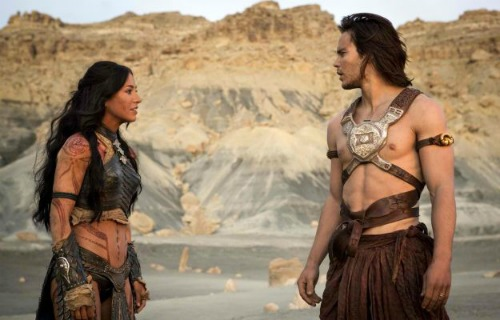
So, The Girlfriend went to her hair stylist last night for the usual maintenance work, and she later told me that while she was in the chair, the smalltalk turned, as I imagine it often does, to recent movies. Anne mentioned to her stylist that she and I quite liked John Carter, only to have the stylist remark that she wasn’t interested in that one because she couldn’t really tell what it was about from the TV ads. So Anne — who I think is on the verge of becoming a genuine Edgar Rice Burroughs fan, thanks to our nightly readings from the Barsoom series (we’re about two-thirds of the way through book two, The Gods of Mars, right now) — proceeded to explain what the movie’s marketing did not: that it was a swashbuckling adventure based on a seminal century-old sci-fi/fantasy pulp novel by the same author who created Tarzan… at which point, her stylist said something to the effect of, “Really? It’s based on a book? By the guy behind Tarzan? I totally would’ve seen it if I had known that!”

You see how easy it would’ve been, Disney marketing people? Bunch of schmucks…

spacer

I Have a Confession

Psst. I have to tell you something. Something I’m not proud of. It’s pretty embarrassing, actually. Not “I caught herpes from the town skank” embarrassing. More in the range of “I had to take my sister to the prom because no one else would go with me.” But still, it’s bad enough…

You see, when I was younger — much younger, you understand — I went through a phase when I, um, actually kinda-sorta liked the artwork of… are ready for this? Thomas Kinkade.

Yes, that Thomas Kinkade, the self-proclaimed “Painter of Light” whose highly sentimental paintings of quaint cottages and Victorian holiday scenes and just-too-perfect landscapes have been licensed to appear on everything from Christmas-tree ornaments to calendars and greeting cards, to “collectible” plates to, I don’t know, sanitary napkins, probably. The guy who earned fortunes selling mass-produced kitsch to the QVC crowd while being utterly reviled by serious art lovers. Yeah, him.

As I said, I was young. And I had what seemed like perfectly legitimate reasons at the time. It happened just after I got back from a month-long stay in Cambridge, England, back in 1993. It had been my first time away from home on my own, the fulfillment of a wish I’d nurtured for a very long time, and I loved just about everything about the experience, and about the place. I was especially taken by the soft, fluid quality of the light over there, especially as evening approaches and the summer twilight stretches out for hours after the sun actually goes down. It was so different from the crystalline desert skies I was accustomed to back home… and it was so difficult to describe to my friends and family when I returned.

And then I stumbled across a painting that seemed to capture the qualities I remembered. I think it may have been this painting right here:

thomas-kinkade_lamplight-inn

That’s Kinkade’s “Lamplight Inn,” released in 1994 according to the info I found, so the timing coincides nicely with my return from Cambridge and period of maximum nostalgia for the place. Looking at it now, nearly 20 years down the line, I’m not quite sure why it reminded me so strongly of my beloved Cambridge, what specifically I saw there that so strongly activated my memories. But it did. The bridge was probably a factor, as there are a number of bridges on the river Cam that look like that. And the lights reflecting in the water remind me of several wonderful evenings. In any event, I decided I liked this painting’s evocative power, and I developed a brief infatuation with Kinkade’s work. I enjoyed it for exactly the reasons, I imagine, his hardcore fans do: his idealized vision of a cleaner, simpler world appealed to my desire for escape and peace. And I thought many of his paintings were simply pretty to the eye. To tell the truth, I still like a couple of them.

But as time passed, my feelings toward Kinkade started to curdle. First, I thought it was tacky when he trademarked the “Painter of Light” nickname. Then his paintings seemed to cross the line from colorful to garish, and their nostalgic tone started to feel more like calculated schmaltz. They began to strike me as cutesy, and one thing I cannot abide is cutesy. I was also repelled when he started wearing his religion on his sleeve and infusing simple subjects with overwrought symbolism. No offense to any of my readers who may actually like cutesy religious paintings, but they’re not my thing.

The biggest problem, though, was the ubiquity of his work. I’ve said before I actually tend to prefer commercial illustration to fine art, so I wasn’t bothered by Kinkade’s stuff being mass-produced, at least not in principle. But the licensing got so out of hand — this crap really was everywhere, and on everything, and it got very tiresome.

And then came the revelations that Kinkade wasn’t the good Christian he proclaimed himself to be, that he was actually fleecing the poor believers who’d bought into his franchised gallery business, and that he frequently behaved like a drunken boor… well, I decided I was done with Thomas Kinkade at that point. Now when the subject comes up, I feel like I do when I’m suffering a mild hangover: slightly ill, and vaguely ashamed of myself.

Even so, I was shocked and a bit saddened to hear that he died this past weekend at the age of 54. That’s only 12 years older than myself, way too early in my book. And once upon a time, I really did find value in at least some of his paintings. So I offer my sincere condolences to his family and to his fans…

spacer

What If You Went to the Bottom of the Sea and Nobody Cared?

One of the more depressing aspects of living in the current epoch, at least for me, is a nagging sense that the days of the Great Adventure are over. What do I mean by this? Consider: throughout much of the 20th century, larger-than-life men and women were constantly pushing the boundaries of how far, how high, and how fast human beings could go, either making or contributing to extraordinary scientific discoveries along the way, and all with the full attention and support of the general public. Viewing the popular movies and newsreels of decades past, and reading the contemporary pulp fiction (which I believe is often more representative of a particular milieu than the “good” stuff), you can really feel the shared sense of excitement ordinary joes must have vicariously experienced as daring aviators flew solo across the Atlantic for the first time, then circumnavigated the globe by plane, then broke the sound barrier and ventured to the edge of outer space; as intrepid explorers uncovered the tomb of Tutankhamun and located the legendary city of Macchu Picchu high in the mountains of South America; as hardy adventurers reached the poles and summited Mount Everest; and ultimately, as astronauts first stepped onto the surface of another planetary body. The word “progress” meant something unambiguously positive then, and it must’ve seemed to folks living in those heady times as if the human race was really going… well, somewhere. I personally came along a little too late to share in that zeitgeist firsthand, but even in my own youth during the 1970s and ’80s, I recall the public imagination being captured by the early space shuttle launches, by the first untethered spacewalk by an astronaut with a jetpack, and by Dr. Robert Ballard’s discovery of the most famous shipwreck in history, RMS Titanic, lying in the silent darkness two-and-a-half miles below the surface of the ocean.

Nowadays, though… things are different now. Here in the second decade of the 21st century, every square foot of the Earth’s surface has been mapped and photographed from orbit. Ancient cities lost for centuries in desert sands and steaming jungles can be pinpointed from air-conditioned rooms in anonymous suburban office parks using thermal imaging satellites. Any place on the globe can be reached by air in a matter of hours. African safaris and Everest hikes are vacation destinations for those who can afford them. And even distant worlds are accessible to the human race as never before, via our robot proxies and the information-sharing power of the Internet. And that’s all good, it really is. Many of those early adventurer/explorers I romanticize met with pitiful and/or horrific deaths because they had to be there in person, and the folks back home never got more than just a glimpse of the sights they saw and things they learned. Today, technology has made discovery much safer, and it’s made it truly democratic as well — everyone can view the latest photos from the Hubble telescope or the surviving Mars rover, or zoom in on some section of the globe at the click of a mouse. People can even participate if they like, though projects like SETI@home. But the trade-off, unfortunately, and the irony as well, is that just at the moment when the average citizen can become more involved in this sort of thing than ever before, not many people seem to care anymore. Exploration and discovery seem to have become, at least as far as I can tell, a niche enthusiasm that attracts a relative few, rather than a society-wide concern.

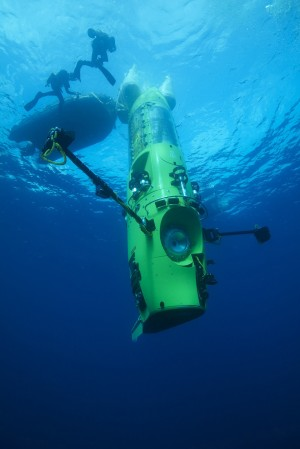
Why else would there have been so little apparent interest three weeks ago when James Cameron — yes, that James Cameron, the writer/director of Titanic, Avatar, and, somewhat prophetically, The Abyss — joined the ranks of the great explorers by riding a revolutionary new submersible to the bottom of Challenger Deep, the very deepest point in all of Earth’s oceans? To my mind, this was a Big Damn Deal. The sort of thing that strangers on trains should’ve been talking about for days afterwards, worthy of front-page articles and magazine covers. Instead, it seems to have been a mere blip on the cultural radar, duly noted and then shoved aside with the turn of another 24-hour news cycle. There are follow-up stories out there, but you have to seek them out if you’re interested. And my inner cynic can’t help but wonder with a sour grumble just how many of the mouth-breathers walking around out there actually are interested. Neither he nor I like the odds much.

To be fair to the mouth-breathers, though, a big chunk of the blame for the indifference that surrounded this story must be thrown at the media. There wasn’t much news about Cameron’s plans beforehand — I myself only heard about the expedition by chance a couple weeks prior, via the blog Boing Boing, if I remember correctly — and, as I said, the coverage of the actual dive has been perfunctory at best. I guess a good old-fashioned adventure is just not that important at the moment, not when there’s an endless race for the Republican presidential nominee to focus on, and hey, did you hear Snooki’s pregnant, and of course Facebook just bought Instagram, whatever the hell that is. If people who don’t follow certain types of blogs aren’t hearing about expeditions like Cameron’s, why should they care?

I also wonder if perhaps part of the problem is James Cameron himself. My mother’s reaction when I told her about the expedition was something to the effect of, “Why him?” And I imagine that’s not an unusual reaction. He’s a filmmaker, after all, not any sort of scientist (although the National Geographic Society has named him an explorer-in-residence, and he’s made over 70 deep submersible dives in the last couple decades, which I think qualifies him for this). That “king of the world” thing at the 1998 Oscars still sticks in some people’s craws, and he has a reputation for being a royal son-of-a-bitch to work with. But hey, let’s be honest: I think a certain degree of arrogance is probably a requirement to doing something like this. You have to believe that the thing can be done, and you have to believe you’re the one who can do it, and both require a sizable belief in oneself. In this case, Cameron wasn’t the first human to journey into the Challenger Deep — two men did it in 1960 with the help of the U.S. Navy and a submersible “bathyscaphe” called the Trieste — but he is the first to do it in 52 years, and the first to do it solo. And the conditions he knew he’d be facing were pretty daunting, even with a half-century of technological advancement since the Trieste.

Cameron’s submarine, the DEEPSEA CHALLENGER, dropped seven miles straight down into the Pacific Ocean, the downward journey taking close to three hours while his six-foot-plus body was folded into a steel sphere only 43 inches in diameter. The pressure outside grew to an astonishing 16,285 pounds per square inch — barely less than the pilot sphere’s rated capacity of 16,500 psi — pressure so intense that the sub actually shrank in height by a couple of inches. Meanwhile, the temperature inside Cameron’s sphere fell from uncomfortably warm near the surface (because of the electronics and Cameron’s own body heat in such a confined space) to meat-locker cold at the bottom of the sea. And of course it was pitch black at the bottom. He was all alone in utter darkness farther below sea-level than Mount Everest rises above it, trusting that the engineers who designed and built DEEPSEA CHALLENGER hadn’t overlooked anything. In other words, this situation was very much like a flight into space… and as much as I admire astronauts for their drive and guts, I admire James Cameron for his.

The Sunday he went down, March 25, I was following along on Twitter, a service I normally find rather silly, but that day it was the only place I could find any news. I was on the edge of my seat as each new update came in from the expedition, ticking off the latest depth he’d reached, the time elapsed since he’d submerged, etc. And when Cameron’s own tweet flashed across the Internet — “Just arrived at the ocean’s deepest pt. Hitting bottom never felt so good. Can’t wait to share what I’m seeing w/ you” — I exhaled a breath I didn’t know I’d been holding, and thought of the words of Charlie Duke, the CAPCOM on the Apollo 11 mission, when Neil Armstrong radioed back that the Eagle had landed: “Roger, Tranquility. We copy you on the ground. You got a bunch of guys about to turn blue. We’re breathing again. Thanks a lot.” (Sidenote: How bizarre is it to think that a man was able to send a “tweet,” surely one of the most frivolous means of communication ever invented, from the bottom of the ocean? We really are living in the future, aren’t we?)

I don’t know… maybe a moment like that doesn’t do anything for you. Maybe this really is just one of my esoteric and slightly backward interests, like old movies, something that the vast majority of the population no longer has any use for. Another example of how I should’ve been born a generation or two back. These days, there are a lot of people out there who feel we shouldn’t bother trying to put human beings into space or other hostile environments; it’s too expensive, they say, and too dangerous to justify what we get back, and anyhow we can learn all we need to know with cheap, efficient robot probes. I don’t know if these people are in the majority. They certainly seem to have the loudest voices sometimes. And that just makes me sad, and frustrated. Because the world of the early 21st century feels too bloody tame to me. I’m so grateful that every once in a while, somebody like James Cameron comes along and does something to demonstrate that there are still frontiers to be crossed, and it’s much more interesting to cross them in person, if only somebody is willing to cross them.

deepsea-challenger


spacer

The President Is One of Us!

Happily ganked from Jaquandor:

obama_with_nichelle-nichols

History has already recorded that Barack Obama was the first black president of the United States, but personally I think it’s important to note that he’s also our first Trekkie president… at least the first who’s willing to own up to it! Look at that grin… he’s as thrilled as any of my fellow nerds to be standing next to a pop-cultural legend, the lovely Nichelle Nichols, a.k.a. Lt. Uhura from the original Star Trek.

For the record, Nichelle was the first celebrity I ever encountered. It was at a one-day Star Trek mini-con held at the Salt Lake Airport Hilton back in ’87 or ’88, during my freshman year of college. To place that in some context, the last Trek movie to play in theaters had been Star Trek IV: The Voyage Home — that’s the one with the whales, for you civilians out there — the previous year, and Star Trek: The Next Generation had just gotten off to a bumpy start in television syndication. (I didn’t think it would survive its first season, to be honest. Boy, was I wrong!) I’ll admit to being a wee bit awestruck when I found myself standing on the other side of an autograph table from a woman I’d been watching on TV since before I could remember, but to my everlasting gratitude, Nichelle turned out to be as warm, gracious, friendly, and beautiful in person as she’d ever been on screen. It looks to me like none of that has changed…

spacer

This Is Going to Happen to Me Someday…

I just know that one of these days the amount of books inside my home is going to reach some critical mass that exceeds the structural limitations of the house itself, and then…

book-flood

(This is actually an art installation in Madrid, Spain; I’m normally not too keen on modern art “installations,” but this one amuses me. Details and more pictures — and even a video of the thing in motion, because those are actual books that blow around in the breeze — here. And I found it via Boing Boing, naturally.)

spacer

Nobody Is Safer

nobody-is-safer

Over the past week, the British magazine The Economist has been hosting an online debate between security consultant (and highly vocal TSA critic) Bruce Schneier and former TSA administrator (and current TSA apologist) Kip Hawley over whether, in fact, post-9/11 airport security procedures have done more harm than good. My own views line up nearly one-to-one with Schneier’s: I think the rigamarole you have to go through to get on a plane these days is needlessly demeaning, intrusive nonsense designed to make it look like the government is doing something to make traveling safer, but which ultimately accomplishes little except inconveniencing and intimidating travelers. (For one thing, all the procedures are designed to stop whatever the last would-be terrorist attempted to do; logically, that just means the next attempt will be something new that the TSA’s not screening for.) I could go on at length about this, and about how incredible I find it that a people who genuflect to the concept of individual liberty are so willing to simply “hand over their papers” (so to speak) when somebody in uniform demands them, as long as they think they’re doing it in the name of their own safety. But instead I think I’ll just quote the final two paragraphs of Schneier’s closing remarks:

The goal of terrorism is not to crash planes, or even to kill people; the goal of terrorism is to cause terror. Liquid bombs, PETN, planes as missiles: these are all tactics designed to cause terror by killing innocents. But terrorists can only do so much. They cannot take away our freedoms. They cannot reduce our liberties. They cannot, by themselves, cause that much terror. It’s our reaction to terrorism that determines whether or not their actions are ultimately successful. That we allow governments to do these things to us–to effectively do the terrorists’ job for them–is the greatest harm of all.


Return airport security checkpoints to pre-9/11 levels. Get rid of everything that isn’t needed to protect against random amateur terrorists and won’t work against professional al-Qaeda plots. Take the savings thus earned and invest them in investigation, intelligence, and emergency response: security outside the airport, security that does not require us to play guessing games about plots. Recognise that 100% safety is impossible, and also that terrorism is not an “existential threat” to our way of life. Respond to terrorism not with fear but with indomitability. Refuse to be terrorized.

The whole of the debate is worth skimming, although I remained totally unconvinced by Hawley’s arguments, which seem to basically consist of “hey, nothing’s happened, so we must be doing something right!” and “we’ve had lots of successes, we just can’t tell you about them.” I found Schneier’s comment that airports have become effectively “rights-free zones” where TSA “officers” can do pretty much anything they want to you and your belongings in the name of “security” especially trenchant… and chilling. Just lately, though, I’ve been seeing some signs that the tide may be turning, that people may be regaining a bit of sanity a bit on this subject, or perhaps they’re just getting tired of minimum-wage rent-a-cops feeling up their grandmas and confiscating their baby formula. Either way, I fervently hope we’re eventually going to ratchet things down to something that more resembles the way it was when I first started flying.

It’d be lovely to be able to go to the airport for a hotdog and an afternoon of people-watching again…

spacer

Awesome Space Image of the Day

thrusters

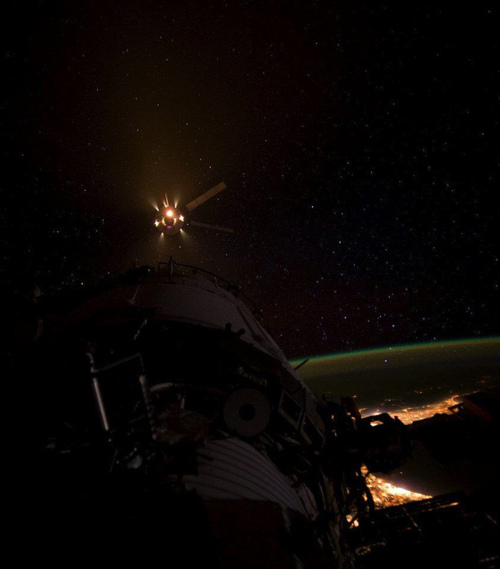
That’s a snap of an unmanned cargo ship — technically referred to in NASA-speak as an Automated Transfer Vehicle — firing its maneuvering thrusters as it approached the International Space Station yesterday. This image was taken by astronaut Don Pettit aboard the ISS, and I think it’s simply incredible. Even just a few years ago, you could only see something like this on a fictional TV show like Deep Space Nine or Babylon 5, but here it is, actually happening right over our heads, captured on a perfectly ordinary digital camera and posted to both Twitter and Flickr like any old photo of somebody’s cat. The future hasn’t turned out to be quite what we were promised as kids, but every once in a while, it comes close.

Go here for a couple more…

spacer

Sometimes We Move Backwards

This morning, Boing Boing linked to an article I found interesting, on the way science-fiction stories often feature apparent “gaps” or imbalances in the technology of their imaginary worlds, and why those gaps are not necessarily a failure on the writer’s part. The starting point for the article was the current phenom movie The Hunger Games and the books from which it is adapted. I haven’t read or seen The Hunger Games myself, but apparently the story has drawn a certain amount of criticism because the futuristic dystopia in which it is set (supposedly descended from our own United States of America following some kind of apocalypse) includes such high-tech flourishes as hovercraft, force fields, and genetically engineered animals, but it still relies on coal-fired powerplants for electricity and has nothing resembling the Internet. Some readers/viewers question the idea of a society that’s so advanced in some ways but not in others. The article goes on to make the argument that real societies choose to adopt or abandon technologies for all sorts of reasons — political, economic, and/or cultural — and the seeming flaws of imagination in this story can be explained quite logically, given the assumptions of the society in question. The whole thing reminded me of what I said a couple weeks ago regarding the usage of swords in so much of the “planetary romance” sub-genre of science fiction, i.e., that it’s not at all unreasonable for John Carter or Flash Gordon to fight the bad guys with a sword while anti-gravity airships hang overhead, because Barsoom and Mongo have societies that, for whatever reason, still value prowess with a blade, even though firearms are available. Because, you know, swordfighting is cool. Especially in stories, which are all this stuff really is, after all.

And just in case you still don’t buy the notion that a society really might choose to go deliberately retro or turn its back on certain technologies, consider the somewhat depressing final line from that Boing Boing post:

A decade ago, you could fly London to New York in a couple of hours. A year ago, America had a reusable spacecraft.

But not now. Because we decided those things were no longer economical. Or necessary.

spacer

Surely… The Best of Times

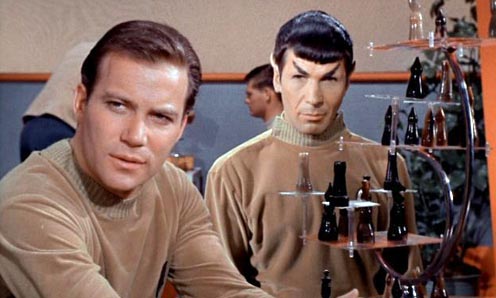
star-trek_kirk-and-spock-in-pilotIn what seems to be turning into an annual tradition here at Simple Tricks, I’d like to wish a very happy birthday to the one and only William Shatner, who turns 81 years old today, and also to his friend and Star Trek costar Leonard Nimoy, who will be 81 as well on Monday. Their fictional counterparts, Kirk and Spock — as well as Doctor “Bones” McCoy, played by the late DeForest Kelley — were among my earliest heroes. They found their way into my life when I was a very small boy, and their example of loyalty, chemistry, camaraderie, and, yes, genuine love for each other strongly influenced my idea of what male friendship can and ought to be.

My thanks to Christopher Mills over at Space: 1970 (a really excellent blog if you, like me, happened to have been a sci-fi lovin’ kid during the “Me Decade”) for reminding me of this…

spacer