
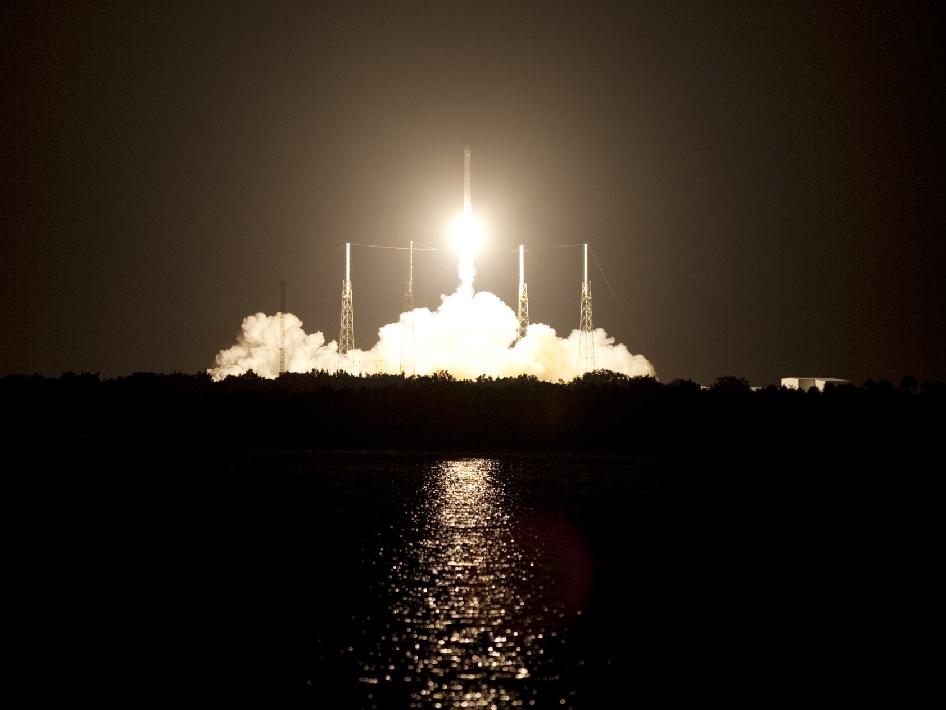
The SpaceX Dragon spacecraft, which took off Sunday evening in the spectacular nighttime launch seen above, successfully docked with the International Space Station first thing this morning. This is the first official cargo run of the dozen SpaceX is contracted to handle for NASA. (The Dragon carried some cargo on that groundbreaking flight a few months ago, but that was still technically just a shakedown cruise; the Dragon is now considered fully operational.) The era of true commercial spaceflight has begun; welcome to the future.
The mission hasn’t been all smooth sailing, though. The first stage of the SpaceX Falcon-9 booster rocket lost one of its engines during the ascent, but despite how it appears in the rather alarming video that’s been floating around, SpaceX insists the engine did not explode. Apparently, there’s some kind of a fairing around the engine that came apart — that’s the debris you can see in the video — and the engine automatically shut down, but continued to transmit data, which it would not have done if it’d gone boom. In any event, the Falcon — like the space shuttle and the Saturn rockets before it — was designed to make it to orbit with a dead engine, and this incident was ample demonstration that the failsafe design works.
The Dragon is scheduled to remain at the station for 18 days before returning to Earth with over 800 pounds of research samples and other material the ISS crew is sending home.
In other SpaceX-related news, the company recently fired up its “Grasshopper” testbed, essentially just a rocket motor attached to a set of spindly landing legs, and successfully hovered it for about three seconds. That doesn’t sound very impressive, I know, but the company’s ultimate goal is to someday have its Falcon boosters and possibly the Dragon capsules themselves return to their launch site and land vertically, on their tails and under power, just like the silver-winged rocketships in all those old 1950s sci-fi flicks. The Falcons are currently one-use-only disposables, and the Dragons have to be laboriously recovered at sea; bringing them home in this fashion would cut expenses considerably, and make the Falcon/Dragon combination into something much closer to a truly reusable spacecraft than the shuttle ever was (as much as it pains me to say that). And, also… 1950s-style rocketships! How cool would that be? Needless to say, I’ll be watching this Grasshopper thing with great interest…
